tron
TRON Network 2026: Volume, Fees and Real Costs
On this page
- What is the TRON network?
- TRON Network 2026: The Numbers That Matter
- How TRON Became the USDT Network
- TRON Cross-Chain: How Liquidity Flows In
- What All This Activity Costs You
- Frequently Asked Questions
- What is the TRON network used for in 2026?
- Is TRON a good blockchain?
- How many transactions does TRON process per day?
- Does TRON have more USDT than Ethereum?
- How much does a TRON transaction cost?
- The Bottom Line
TRON moved $2.0 trillion in USDT during the first quarter of 2026. That is about 36% of every USDT transfer on every chain, packed onto a network that settles a block every three seconds. Look closely at the TRON network 2026 picture and one number repeats underneath the headlines: the wallets behind those transfers either paid for energy, or they burned 6-13 TRX every time they hit send.
This is the state of TRON now, what is driving it, and what it costs you to use.
What is the TRON network?
The TRON network is a Layer 1 blockchain built for cheap, fast stablecoin payments. It runs Delegated Proof of Stake with 27 elected validators and the TRON Virtual Machine, processes about 138 transactions per second, and confirms a block every 3 seconds. Most people meet TRON crypto through one action: sending USDT, the TRC-20 stablecoin that makes up the bulk of the network's traffic.
That payments focus is the whole story. TRON is not chasing the broadest DeFi ecosystem or the fanciest virtual machine. It optimizes for one job, moving dollars, and in 2026 it does that job at a scale no other chain matches. If you are new to the network, how TRON energy works is the first mechanic to learn, because it sets what every transfer costs.
TRON Network 2026: The Numbers That Matter
Q1 2026 turned almost every TRON growth metric into a record. Here is the state of the network, drawn from the CoinDesk and Messari quarterly reports.
Evidence:
- USDT supply on TRON hit an all-time high of $85.4 billion, around 46% of all USDT in circulation.
- TRON processed $2.0 trillion in USDT transfer volume, second only to Ethereum's $2.2 trillion.
- Average daily transactions in Q1 rose 7.0% quarter over quarter to 10.9 million.
- Average daily active addresses climbed 13.7% to 3.2 million, behind only Solana among major chains.
- Protocol fees reached $82.2 million, second among Layer 1 networks behind Hyperliquid.
Total transaction count tells the same story over a longer arc: from 801 million in Q2 2025 to 950.7 million in Q1 2026.
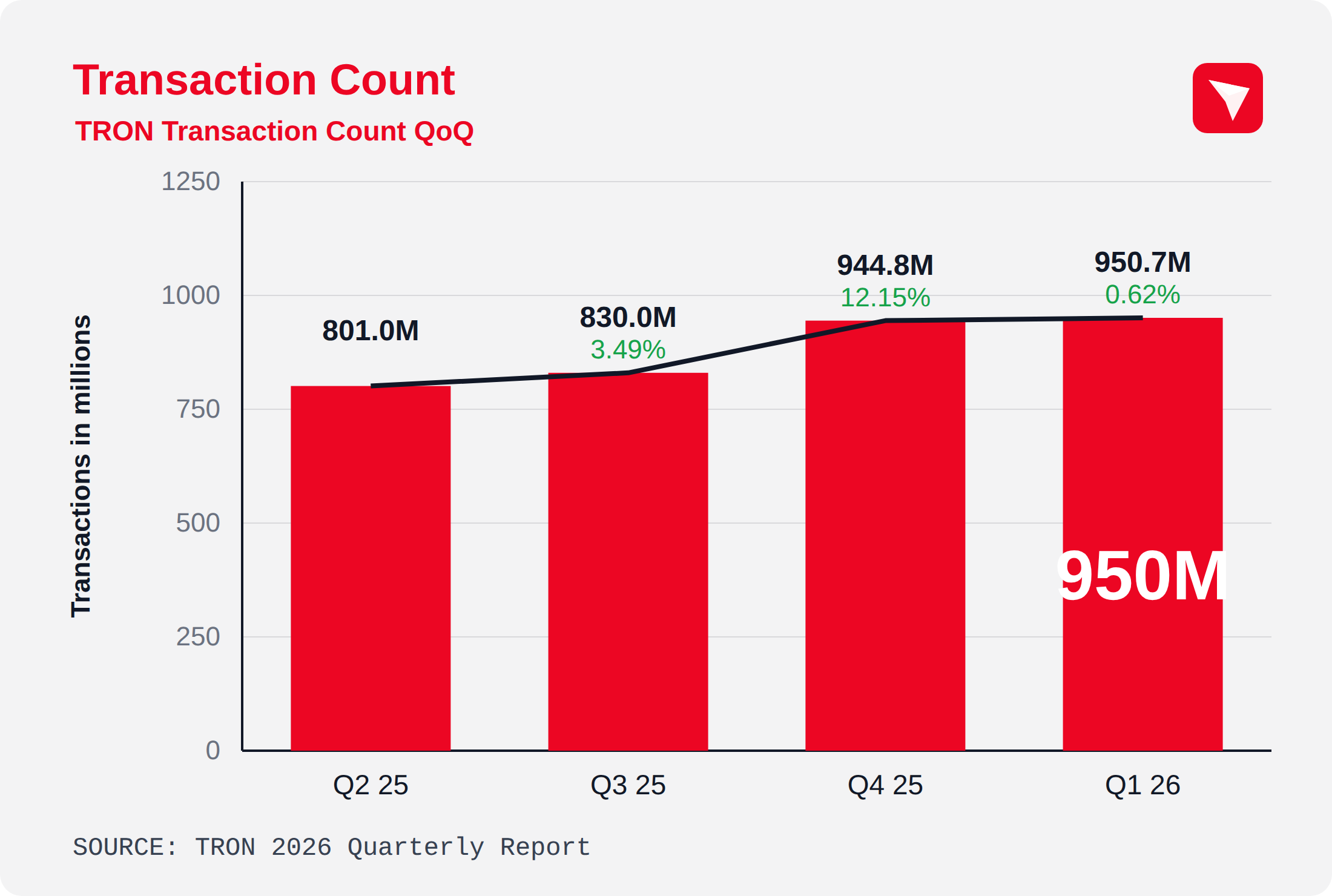
Source: TRON 2026 Quarterly Report
The momentum carried into Q2. On June 10, 2026, TRON daily transactions hit a new all-time high of 14.3 million, well above the Q1 average.
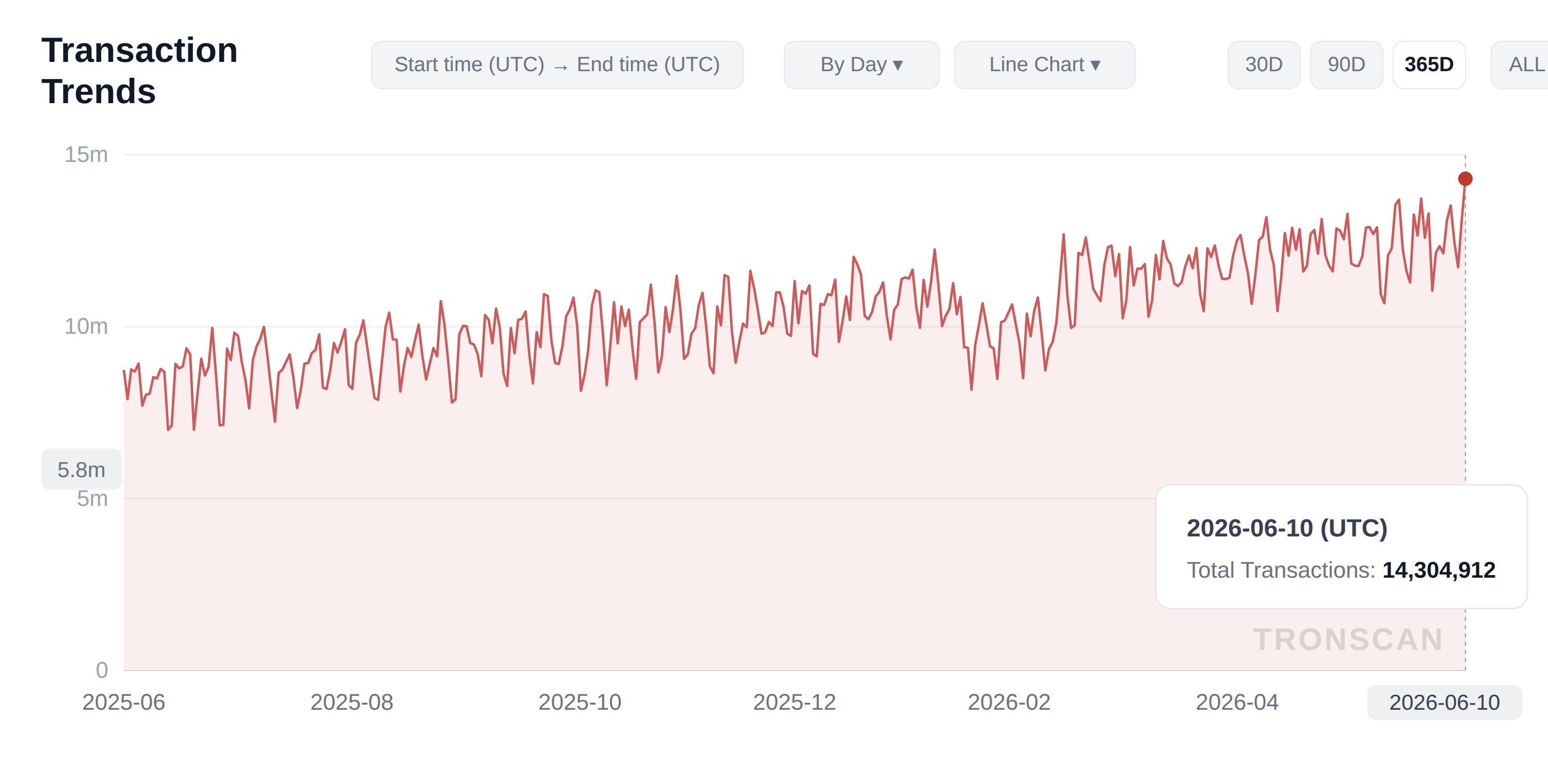
Source: Tronscan
| Metric (Q1 2026) | Value | Change |
|---|---|---|
| USDT supply on TRON | $85.4B | All-time high |
| USDT transfer volume | $2.0T | 36.3% of all chains |
| Daily transactions | 10.9M | +7.0% QoQ |
| Daily active addresses | 3.2M | +13.7% QoQ |
| Protocol fees | $82.2M | 2nd among L1s |
About 60% of TRON's daily active users move funds wallet to wallet, the highest share among the chains tracked, down from 78% a quarter earlier as bridges and apps grew. The shape is clear: TRON is a payments network first.
The TRON network in 2026, in one line: TRON carries more USDT than any other chain ($85.4 billion supply, $2 trillion quarterly volume) and averages about 10.9 million transactions a day, with a single-day record of 14.3 million on June 10, 2026.
How TRON Became the USDT Network
USDT on TRON crossed a line in 2026 that the market watched for years: the network now holds more USDT than Ethereum. Three practical reasons pulled Tether's volume here.
Cost. A funded TRON transfer costs a few TRX of energy, against gas fees on Ethereum that can run dollars per send during busy periods. For someone moving stablecoins daily, that gap compounds fast.
Speed. TRON confirms in about 3 seconds. Ethereum averages closer to 12. When a buyer is waiting on the other side of an OTC trade, seconds matter.
Reach. Exchanges, OTC desks, and payment apps default to TRC-20 USDT, so liquidity sits where the rails already are. For desks settling trades across Southeast Asia and Latin America, TRON became the default channel because a transfer clears in seconds and costs cents when energy is handled right.
Why USDT is bigger on TRON than Ethereum: TRON settles a USDT transfer in about 3 seconds for a few cents of energy, versus minutes and higher gas on Ethereum. That speed and cost gap pushed TRON's USDT supply past Ethereum's in 2026, to $85.4 billion.
TRON Cross-Chain: How Liquidity Flows In
All that USDT does not start on TRON. It arrives. TRON cross-chain infrastructure grew quickly in 2026, and the way liquidity bridges in shifted toward native assets over wrapped ones:
- deBridge moves value across chains with a 0-TVL design and delivers native USDT on TRON, not a wrapped token.
- LI.FI and Jumper integrated TRON, unlocking cross-chain stablecoin liquidity for the apps and front ends built on their routing.
- Symbiosis added fast TRC-20 bridging for users hopping in from EVM chains.
Here is what the bridge guides skip. The moment your USDT lands on TRON, sending it onward is a smart-contract call, and that call needs energy. Bridge in $10,000 of USDT and your first transfer out still burns roughly 65,000 energy, or 6-13 TRX if your wallet holds no energy. Bridging solves where your dollars live. It does nothing for what they cost to move once they get there, which is what a USDT transfer costs in practice.
What All This Activity Costs You
Strip away the macro story and every transaction on the network shares one cost: energy. Each USDT (TRC-20) transfer consumes about 65,000 energy. If your wallet has none, the network burns 6-13 TRX to cover it, roughly $1.40 to $3.00 per send at a TRX price near $0.23.
Cost of one USDT transfer on TRON: A USDT transfer uses about 65,000 energy. Without rented or staked energy, the network burns 6-13 TRX (around $1.40 to $3.00). Renting energy instead cuts that cost by 80 to 95%.
You have three ways to cover the energy:
| Option | What you do | Cost for one daily USDT transfer |
|---|---|---|
| Burn TRX | Nothing; pay per send | 6-13 TRX each time |
| Stake TRX | Freeze | Capital locked, 14-day unstake |
| Rent energy | Buy 65,000 energy on demand | ~3.25-5.2 TRX for a 1-day rental |
For anyone sending more than a transfer or two a week, renting wins on both cost and flexibility. You can rent TRON energy on demand and pay only for what you move.
Frequently Asked Questions
What is the TRON network used for in 2026?
TRON is used mainly to send and receive USDT, the TRC-20 stablecoin. In 2026 the network carried $2.0 trillion in USDT transfer volume in a single quarter and settles about 10.9 million transactions a day, most of them retail payments between wallets. Beyond payments, TRON is pulling in cross-chain stablecoin liquidity, but USDT transfers remain the core use.
Is TRON a good blockchain?
Is TRON a good blockchain depends on what you need it for. For cheap, fast stablecoin payments, it is among the strongest options: about 138 transactions per second, 3-second blocks, and the largest USDT supply of any chain at $85.4 billion. It is less suited to complex DeFi or NFT ecosystems, where Ethereum and Solana lead. For moving dollars, TRON is hard to beat.
How many transactions does TRON process per day?
How many transactions does TRON process per day kept setting records through 2026. The Q1 average was 10.9 million, up 7.0% from the prior quarter, and the daily count hit an all-time high of 14.3 million on June 10, 2026. The bulk of that volume is USDT transfers, which is why energy demand tracks transaction count so closely.
Does TRON have more USDT than Ethereum?
Yes. As of Q1 2026, TRON holds more USDT than Ethereum, with a supply of $85.4 billion against Ethereum's smaller share, about 46% of all USDT in circulation. Ethereum still edged TRON on quarterly transfer value ($2.2 trillion versus $2.0 trillion), but TRON leads on circulating supply and on the count of everyday transfers.
How much does a TRON transaction cost?
A USDT transfer on TRON consumes about 65,000 energy. With no energy in your wallet, the network burns 6-13 TRX to cover it, roughly $1.40 to $3.00 at a TRX price near $0.23. Rent energy instead and the same transfer costs about 3.25-5.2 TRX on a one-day rental, an 80 to 95% saving. You can calculate your transfer cost for exact figures, then compare verified energy providers to find the lowest rate.
The Bottom Line
The TRON network in 2026 is a stablecoin engine getting bigger on two fronts at once: record USDT volume and cross-chain liquidity flowing in, both of which add transactions by the day. Every one of those transactions runs on energy.
If you trade or settle USDT regularly, that trend is your cue to stop burning TRX and rent energy on demand, then pick a provider by price and verified TrustScore. If you are building on TRON, plan energy as a line item now, before your volume makes it one for you. And if you are new to the network, learn the resource model before your first transfer so the cost never surprises you.