guide
How to Buy TRON Energy & Bandwidth
On this page
- What is TRON energy?
- Three ways to get TRON energy
- How much does TRON energy cost?
- How to buy TRON energy in 5 steps
- How to choose a provider
- 5 pitfalls that waste your money
- Frequently asked questions
- How much energy does a USDT transfer use?
- Is buying TRON energy safe?
- How fast does rented energy arrive?
- Why did my transfer fail after I bought energy?
- Can I buy TRON energy without holding TRX?
- What happens when the rental period ends?
- Which path fits you
You send USDT on TRON and the network burns about 6.5 TRX from your wallet, or about 13.1 TRX when the recipient has never held USDT. At a TRX price of about $0.33 in October 2026, that is $2.15 to $4.32 gone on a single transfer, and it happens every time you move TRC-20 tokens without energy. If a transfer has ever failed out of energy on you mid-payment, the same mechanic is to blame. The fix is to buy TRON energy from a rental provider instead: on TRONAgg, a 1-hour rental for the same transfer costs over 70% less than burning TRX. This guide walks through the whole process, from picking a duration to dodging the traps that make first-time buyers overpay.
What is TRON energy?
TRON energy is the network resource consumed whenever a wallet executes a smart contract, and every USDT (TRC-20) transfer is a smart contract call. One standard transfer uses about 65,000 energy units. When your wallet has none, the network burns 6.5-13 TRX from your balance instead. Removing that burn is the single biggest lever in how to reduce TRON fees.
Energy is not a token. You cannot hold it on an exchange or send it to a friend. It exists as an allowance attached to your address, and it arrives in one of three ways: you burn TRX, you stake TRX, or someone delegates it to you. That third path is what a TRON energy rental is. You will also see providers say "buy TRX energy" or "rent TRON energy"; all three phrases mean the same on-chain delegation. For the full mechanics, read our guide to how TRON energy works.
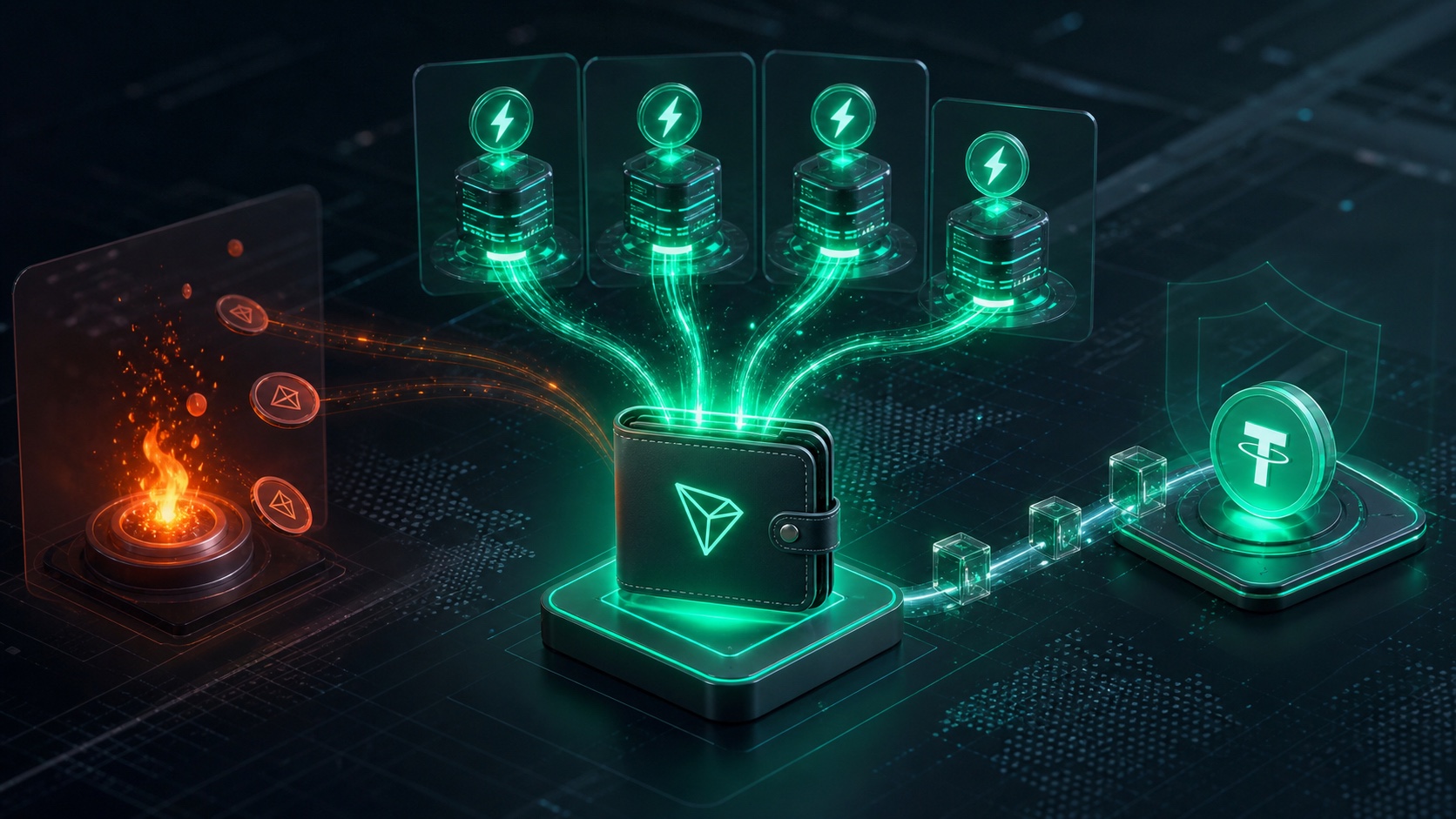
Delegated energy lands on your address before the USDT transfer, so the wallet spends rented resources instead of burning TRX.
Three ways to get TRON energy
The short answer: burning TRX is the most expensive option, staking only pays off above roughly 7,000 TRX of capital, and renting wins for almost everyone else.
| Factor | Burn TRX | Stake TRX | Rent energy |
|---|---|---|---|
| Cost per USDT transfer | 6.5-13 TRX | ~0 TRX after staking | 2.6-3.9 TRX (1-hour market rate, Oct 2026) |
| Upfront capital | None | None | |
| Funds locked | No | Yes, 14-day unstaking period | No |
| Speed to set up | Instant | Instant, but capital-heavy | Seconds to minutes |
| Best for | One-off transfers when you forget to plan | Businesses with large idle TRX | Everyone in between |
Bottom line: if you move USDT a few times a month, rent. If you run a payment desk with six figures of idle TRX, stake. Burning TRX is the default the network falls back on, not a strategy.
The staking math deserves one more line. At the current ratio, 1 staked TRX generates about 9.25 energy per day. Covering a single daily USDT transfer takes roughly 7,027 TRX of stake, locked behind a 14-day unstaking period. Renting gives you the same energy with zero capital tied up.
How much does TRON energy cost?
Providers quote prices in SUN per unit of energy, where 1 TRX = 1,000,000 SUN. The price scales with rental duration: longer rentals cost more per unit because the provider's stake stays committed to you.
Typical market rates as of October 2026 look like this:
| Duration | Price (SUN/unit) | Cost for 65,000 energy |
|---|---|---|
| 1 hour | 40-60 | 2.6-3.9 TRX |
| 1 day | 50-80 | 3.25-5.2 TRX |
| 3 days | 80-120 | 5.2-7.8 TRX |
| 7 days | 120-180 | 7.8-11.7 TRX |
| 14 days | 200-350 | 13-22.75 TRX |
| 30 days | 400-600 | 26-39 TRX |
TRONAgg price: The live price for renting 65,000 Energy for 1 hour on TRONAgg, enough for one standard USDT transfer, is on the pricing page, along with the per-unit rate in SUN.
Why does a month cost 10x more per unit than an hour? Delegated energy comes from the provider's staked TRX, and a 30-day order pins that stake to your address for the full window. The provider prices in the lost chance to re-rent it, so you pay for exclusivity, not just energy.
Two more things matter here. First, the spread between providers is wide: at any given moment, the cheapest and the priciest listing for the same duration can differ by 2-3x. Second, the TRON energy price moves with network demand, so a quote from last week tells you little. Check the USDT transfer cost calculator for a live estimate before you commit.
How to buy TRON energy in 5 steps
The full process takes under five minutes, and you never share a private key.
- Count your transfers: One USDT transfer to an address that already holds USDT needs 65,000 energy. If the recipient holds no USDT, budget 131,000. Multiply by the number of transfers you plan to send.
- Pick a duration: Sending once, right now? Take 1 hour, it is the cheapest rate per unit. Sending throughout the week? A 7-day rental at 120-180 SUN/unit beats re-buying hourly blocks every day.
- Compare prices across providers: This is where most buyers leave money on the table. Use TRONAgg's buy energy flow to see live quotes from every major provider side by side and pick the cheapest one that can fill your order.
- Pay and receive delegation: Enter your TRON address (starts with T, 34 characters) and pay in TRX or USDT. The provider delegates energy on-chain to your address, usually within seconds. No wallet connection, no signatures, no keys.
- Send your USDT: Your wallet now spends delegated energy instead of burning TRX. You can verify the delegation in any explorer under your address's resources tab before sending.
Total cost for a single transfer: around 3 TRX rented at October 2026 market rates versus 6.5 TRX burned. The rental pays for itself on the first transaction.
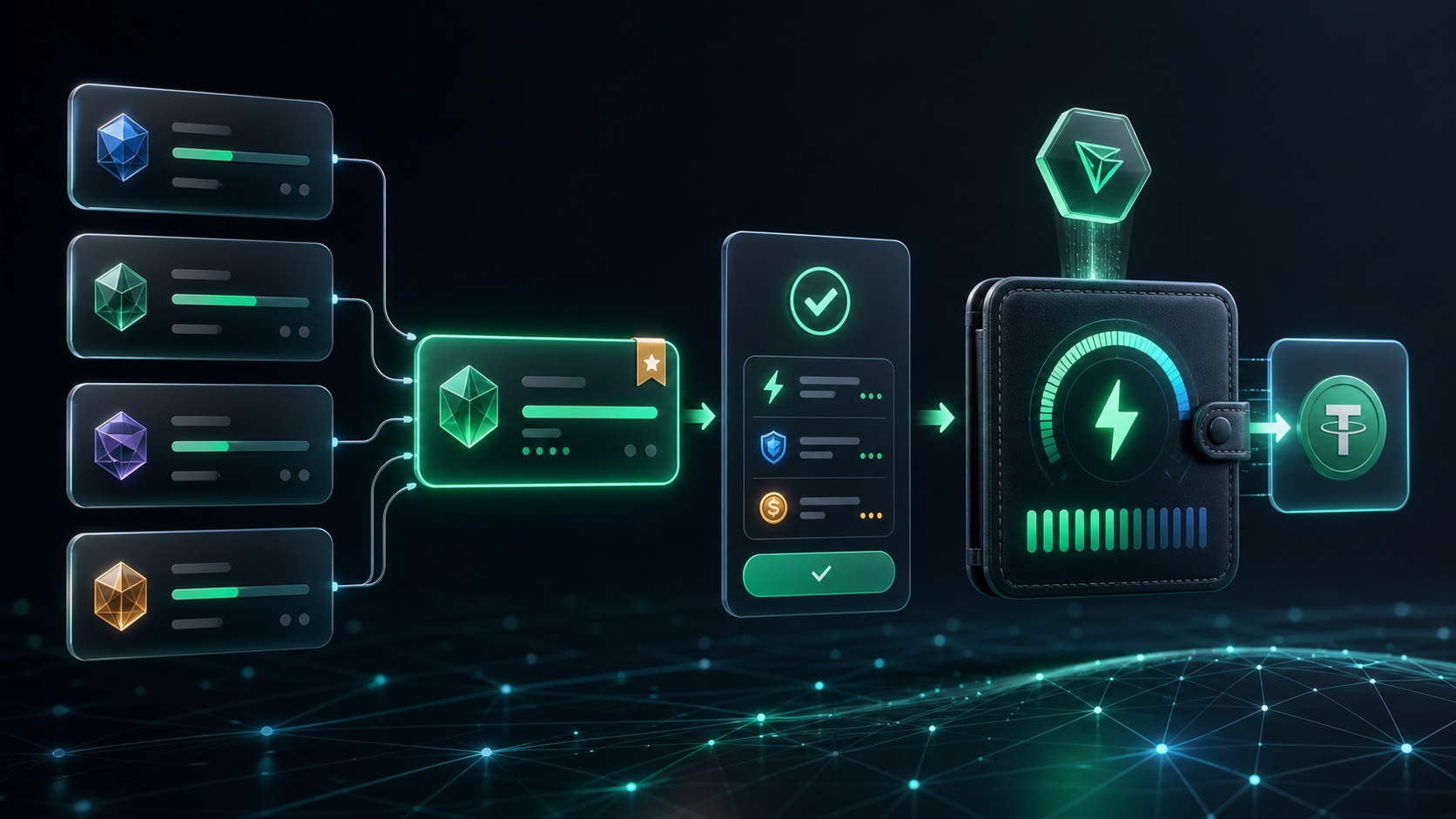
Comparing live provider quotes keeps the order non-custodial while routing the rental to the cheapest provider that can deliver.
How to choose a provider
Price is the first filter, but not the only one. A cheap quote from a provider that fails to deliver costs you more than the spread you saved. Run every candidate through three checks:
- Price per SUN, not headline price: Some providers advertise a low price for a tiny minimum order, then quote worse rates at real volumes. Others set a minimum order above 65,000 units, so the cheap rate only applies to amounts you do not need. Compare the per-unit rate for the exact amount and duration you plan to buy.
- Delivery track record: A provider is only as good as its fill rate. TRONAgg tracks every order and folds delivery history, uptime, and review data into a single rating. Read how the TrustScore rating works before trusting a name you have never used.
- Non-custodial delegation: A legitimate energy provider needs your public address and nothing else. Anyone asking you to connect a wallet with signing permissions, share a seed phrase, or "verify" funds is running a scam, full stop.
The lazy-but-correct shortcut: browse the verified provider list, sort by price, and let the rating filter out the unreliable ones.
5 pitfalls that waste your money
- The empty-recipient trap: Sending USDT to an address that holds none costs 131,000 energy, double the usual amount. Your 65,000-unit rental covers half the transfer, and the network burns TRX for the rest. Check the recipient on an explorer first.
- Forgetting bandwidth: Every transaction also consumes bandwidth on top of energy. Each account gets roughly 600 free bandwidth points per day, while a USDT transfer eats about 345 of them, so the second transfer of the day already runs short and burns ~0.35 TRX instead. If a transfer fails with energy to spare, bandwidth is the usual suspect.
- Unactivated addresses: A brand-new TRON address must be activated by its first incoming transaction, which costs 1 TRX. Delegating energy to a never-used address can fail or strand the energy. Send a little TRX there first.
- Wallet fee displays: Trust Wallet and some others still show the full TRX fee estimate even after your energy arrives, and may block sending if your TRX balance is below that estimate. The energy is there; the display is wrong. Verify the delegation on-chain and keep a small TRX buffer.
- Overbuying duration: A 30-day rental costs 10x the per-unit rate of a 1-hour one. Buy the window you will use. If your transfers are unpredictable, several short rentals beat one long one almost every time.
Frequently asked questions
How much energy does a USDT transfer use?
A standard USDT (TRC-20) transfer uses about 65,000 energy when the recipient already holds USDT. If the recipient address holds no USDT, the transfer writes a new storage entry and consumes roughly 131,000 energy. Other TRC-20 tokens and contract calls vary, but renting TRON energy for USDT transfers covers the bulk of real-world demand on the network.
Is buying TRON energy safe?
Yes, provided the provider only asks for your public address. Energy delegation happens on-chain from the provider's staked account to yours; there is no mechanism in it that touches your funds. The risk is not theft but non-delivery, which is why delivery ratings matter more than a 5% price difference.
How fast does rented energy arrive?
Most orders are delegated within seconds of payment confirmation, and nearly all complete within a few minutes. The delegation is a normal on-chain transaction, so you can watch it land on your address in any TRON explorer.
Why did my transfer fail after I bought energy?
Three usual causes: the recipient held no USDT so the transfer needed 131,000 energy instead of 65,000; your wallet was out of bandwidth and had no TRX to burn for it; or the rental expired before you sent. Check your remaining energy and bandwidth in an explorer, then retry.
Can I buy TRON energy without holding TRX?
Yes. Most providers accept USDT as payment, and aggregators let you pay from a balance funded in either currency. Keep in mind a fresh wallet still needs roughly 1 TRX for activation and a small buffer for bandwidth, so a few TRX on hand saves headaches.
What happens when the rental period ends?
The delegation is withdrawn automatically and your address goes back to its own resources. Nothing to cancel, nothing to return. Unused energy from the rental window does not roll over, which is why matching duration to your actual sending schedule is the main lever on cost.
Which path fits you
For a one-off transfer, rent 65,000 energy for 1 hour, pay around 3 TRX at October 2026 market rates, and send within the window. For regular weekly transfers, a 7-day rental sized to your volume cuts the per-transfer cost to about half a dollar. For high-volume desks, compare a 30-day rental against staking your own TRX; above roughly 7,000 TRX of idle capital, staking starts to win. Whatever your volume, the spread between providers is the easiest money in this market: buy TRON energy on TRONAgg and take the best quote instead of the first one.