guide
Buy TRON Energy Without Staking TRX: Costs and Options
On this page
- Why you can buy TRON energy without staking
- Three ways to get TRON energy without staking
- 1. Rent from an energy marketplace
- 2. Use your wallet's built-in rental
- 3. Burn TRX and skip the preparation
- What renting costs in 2026
- How to rent energy in three steps
- When staking makes sense
- Frequently asked questions
- Do you need to stake TRX to send USDT on TRON?
- How much TRX would you have to stake for one transfer a day?
- Is renting energy cheaper than burning TRX?
- Can you get TRON energy with no TRX in your wallet?
- How fast does rented energy arrive?
- What happens when a rental expires?
- Which route fits you
Ask how to cut USDT transfer fees on TRON and the standard answer is: stake TRX. What that answer skips is the size of the stake. Covering a single USDT transfer per day takes roughly 6,800 TRX of locked capital, about $2,200 at current prices, and getting it back out takes 14 days. Renting the same 65,000 energy costs about 2 TRX and lands in seconds. You can buy TRON energy without staking anything, and for most wallets that is the better deal by a wide margin. This guide covers the three ways to do it, what each one costs, and the one case where staking still wins.
Why you can buy TRON energy without staking
Staking is one of three sources of TRON energy, and the network treats all three the same. Energy reaches a wallet when you burn TRX at send time, when you stake TRX under Stake 2.0, or when someone who staked delegates their energy to your address. A TRON energy rental is that third path: providers hold large stakes, and when you pay them, they delegate energy to your address for the term you picked. On-chain, a transfer powered by rented energy is identical to one powered by your own stake. Providers exist so you can rent energy instead of staking your own capital.
The staking math is what pushes most people to rent. At the current network stake, 1 staked TRX generates about 9.6 energy per day. A standard USDT transfer consumes about 65,000 energy, so producing that much daily means staking roughly 6,800 TRX. At $0.33 per TRX, that is about $2,200 committed to save a few TRX a day in fees. And Stake 2.0 has a 14-day unstaking period, so if TRX moves and you want out, the capital stays frozen for two more weeks. The full resource model is covered in our guide to how TRON energy and bandwidth work.
Buying TRON energy without staking: Rental providers stake TRX at scale and delegate energy to customer addresses on demand. A standard 65,000-energy USDT transfer costs 1.6 to 4.8 TRX to rent at July 2026 market rates, requires no locked capital, and the energy arrives within seconds of payment.
Three ways to get TRON energy without staking
If you skip staking, three routes remain: rent from the open market, rent through your wallet, or let the network burn TRX. They differ in price and in how much preparation each needs.
1. Rent from an energy marketplace
Renting on the open market is the cheapest option per transfer. Dozens of providers sell delegated energy, and their rates are not close: on one July 2026 afternoon, one-hour rentals ran from 24 to 74 SUN per unit across 18 providers, a 3x spread for the same delegated energy. That spread is why comparing beats loyalty. An aggregator shows every provider's live rate in one view, so you can compare prices and buy TRON energy at whatever the cheapest listing is right now, usually 1.6 to 4.8 TRX for a standard transfer.
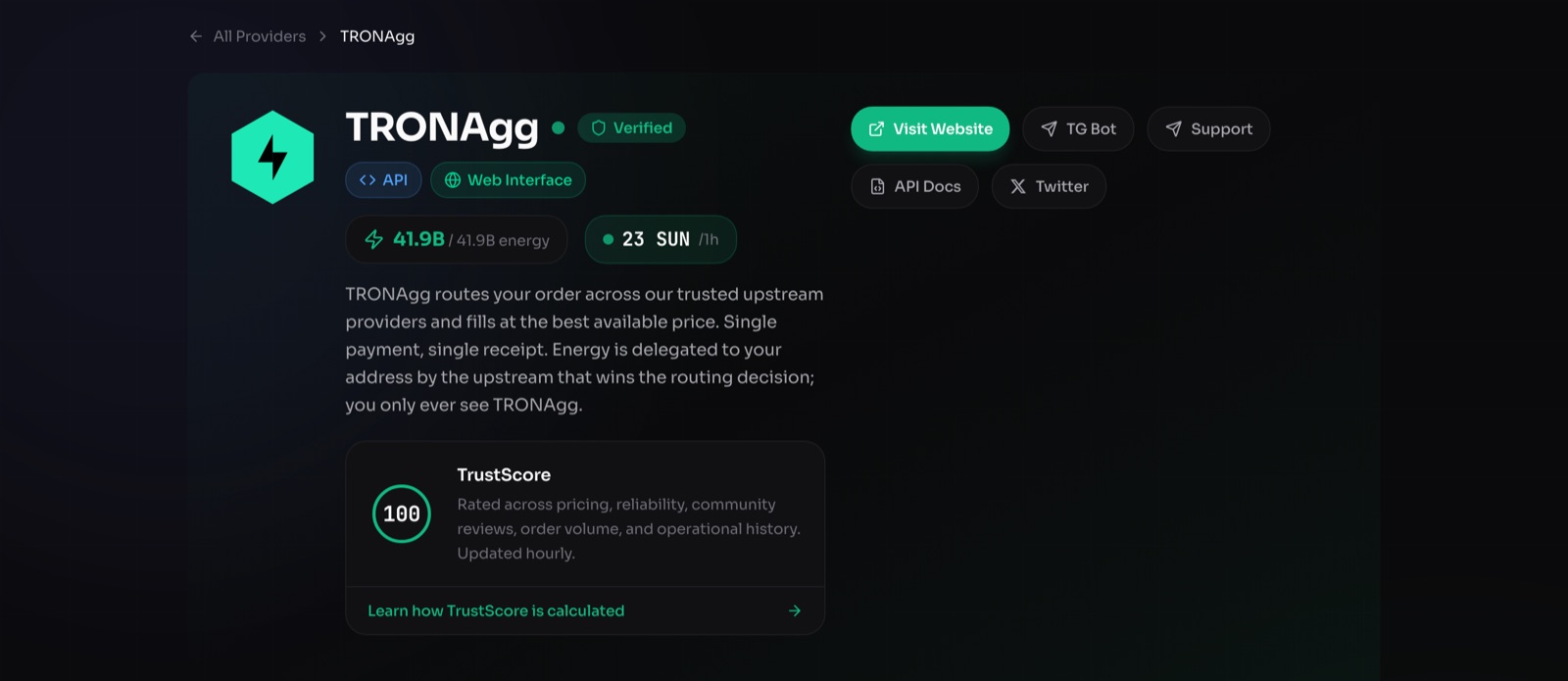
Each provider on the board has a profile like this: verified status, an hourly TrustScore, and the live per-unit rate, all visible before you pay anything.
2. Use your wallet's built-in rental
Several wallets now bundle a rental service into the send flow: toggle it on, and the wallet rents energy for you before broadcasting the transfer. The appeal is zero extra steps. The cost is markup and no choice of provider. Integrated services typically charge 4 to 5 TRX for a transfer the open market covers for 2, because the wallet routes every order to its single partner. One genuine advantage: some integrations let you pay the rental fee in USDT, which matters if your wallet holds stablecoins and no TRX at all.
3. Burn TRX and skip the preparation
Do nothing, and the network handles it by burning TRX from your balance at a rate fixed by governance: 100 SUN per energy unit, which works out to 6.5 TRX for a standard transfer. Sending USDT to a wallet that has never held it doubles the energy to 131,000 units and the burn to 13 TRX. Burning needs no planning and no second transaction, and for a wallet that sends once a quarter, that convenience can be worth the premium. Every other profile should avoid burning TRX, because it is the most expensive rate on the network by design.
| Factor | Marketplace rental | Wallet built-in rental | Burning TRX |
|---|---|---|---|
| Cost per transfer (65,000 energy) | 1.6-4.8 TRX | 4-5 TRX | 6.5 TRX fixed |
| Capital locked | None | None | None |
| Preparation | 1-2 minutes to compare and pay | One toggle at send time | None |
| Provider choice | Full market | Wallet's partner only | Not applicable |
| Best for | Anyone sending weekly or more | Occasional senders who value convenience | Rare, one-off transfers |
Bottom line: the market rental is the price leader, the wallet toggle trades a 2-3 TRX markup for convenience, and burning is the fixed ceiling that both alternatives undercut. The more often you send, the more the marketplace route pays off.
What renting costs in 2026
Rental prices are quoted in SUN per unit of energy, where 1 TRX equals 1,000,000 SUN, and the rate rises with rental length because the provider's stake stays committed to you for the whole term.
| Duration | Typical rate (SUN/unit) | Cost for 65,000 energy |
|---|---|---|
| 1 hour | 40-60 | 2.6-3.9 TRX |
| 1 day | 50-80 | 3.25-5.2 TRX |
| 7 days | 120-180 | 7.8-11.7 TRX |
| 30 days | 400-600 | 26-39 TRX |
Two caveats on the table. First, these are typical ranges, and the cheapest live listing often sits below them: the 24 SUN snapshot above beats the low end of the 1-hour range. Second, rates cycle through the day with USDT transfer demand, swinging 30 to 40 percent between off-peak and peak windows. The mechanics of those swings are covered in our piece on why TRON energy prices change during the day.
The duration menu is the part first-time renters miss. A 30-day rental at 26-39 TRX covers a daily sender's entire month; the same month of burned transfers costs 195 TRX. Matching duration to your sending pattern is where the real savings sit.
How to rent energy in three steps
The whole process takes a couple of minutes and no account setup on most providers.
- Size the order: A standard USDT transfer needs about 65,000 energy; a transfer to an address that has never held USDT needs 131,000. Our guide to how much TRON energy you need covers other contract calls.
- Compare per-unit rates: The SUN-per-unit rate is the only fair comparison across providers, because package sizes and minimums differ. Check a live board rather than bookmarking one provider; yesterday's cheapest seller is often today's mid-priced one.
- Pay and send: Pay the provider, wait a few seconds for the delegation to land on your address, and send your USDT while the rental is active. The transfer consumes the delegated energy instead of your TRX.
For wallet-by-wallet detail, screenshots, and the traps that make first-time buyers overpay, see the full walkthrough on how to buy TRON energy.
When staking makes sense
The energy rental vs staking decision comes down to two questions: do you already hold TRX you plan to keep, and how often do you send?
Staking earns its place when both answers are strong. A wallet that holds 10,000+ TRX as a long-term position and sends several USDT transfers a day converts idle holdings into a steady energy supply at no extra cost, and staked TRX also votes for super representatives, which yields a few percent a year on top. For an OTC desk or a payment processor with treasury TRX sitting in a wallet anyway, staking part of it is free money.
The case collapses when either answer weakens. If you would have to buy TRX to stake, you are taking on price exposure to save single-digit TRX per day: a 10 percent move in TRX swings your $2,200 stake by $220, dwarfing months of fee savings. If your volume is irregular, the daily energy allowance goes to waste on quiet days, because energy regenerates every 24 hours and does not roll over. Before asking how much TRX to stake for energy, run the rental numbers for your real monthly volume; for most senders, a 26-39 TRX monthly rental beats tying up $2,200. High-volume operations often land on a hybrid: stake for the baseline load, rent for spikes.
Frequently asked questions
Do you need to stake TRX to send USDT on TRON?
No. Staking is one of three ways to cover a transfer's energy cost. You can rent 65,000 energy from a provider for 1.6 to 4.8 TRX, or do nothing and let the network burn 6.5 TRX from your balance. Both work with zero locked capital, and the transfer itself is identical on-chain whichever source the energy came from.
How much TRX would you have to stake for one transfer a day?
About 6,800 TRX. Each staked TRX generates roughly 9.6 energy per day at the current network stake, and a standard USDT transfer consumes about 65,000 energy. At $0.33 per TRX, that is around $2,200 of locked capital, subject to a 14-day unstaking period when you want it back.
Is renting energy cheaper than burning TRX?
Yes, always at current rates. The burn rate is fixed by governance at 100 SUN per unit, so a standard transfer burns 6.5 TRX. Rentals ran 24 to 74 SUN per unit in July 2026, putting the same transfer at 1.6 to 4.8 TRX. That is a 26 to 75 percent saving, and the gap widens for transfers to empty wallets, where the burn doubles to 13 TRX.
Can you get TRON energy with no TRX in your wallet?
Yes. Some rental services and wallet integrations accept payment in USDT, so a wallet holding only stablecoins can still rent energy for its own transfer. Watch one detail: the transfer also consumes a small amount of bandwidth, so pick a service that covers bandwidth too, or keep a fraction of a TRX in the wallet for it.
How fast does rented energy arrive?
Seconds. Once the provider sees your payment, it delegates energy directly to your address on-chain, typically within 3 to 10 seconds. There is no account, KYC, or wallet connection involved in the basic flow: energy delegation is a native TRON operation, and the provider only needs your address.
What happens when a rental expires?
The delegation is withdrawn automatically at the end of the term. There is nothing to return and no penalty; unused energy vanishes with it. If you send another transfer after expiry with no energy left, the network falls back to burning TRX, so time your rental window to your sending schedule.
Which route fits you
For a wallet that sends USDT a few times a month or more, rent from the open market: 1.6 to 4.8 TRX per transfer, no capital locked, and a duration menu from one hour to 30 days that scales with your volume. For a one-off transfer, burning 6.5 TRX or flipping the wallet's built-in rental toggle is fine; the savings from shopping around do not justify the minutes spent. And if you hold five figures of TRX for the long haul while sending daily, stake a slice of it and rent only the overflow. Whichever profile is yours, the numbers favor checking live rates before you pay: the same energy trades at a 3x spread on any given afternoon.