guide
TRON Energy Calculator: What Every Transfer Costs
On this page
- What does a TRON energy calculator do?
- The formula: calculate TRON energy costs by hand
- How much energy common transactions use
- Burn vs stake vs rent: three ways to pay
- What renting TRON energy costs by duration
- Using the live calculator on TRONAgg
- Frequently asked questions
- How much energy do I need for a USDT transfer?
- How much TRX does one USDT transfer cost?
- Why does sending USDT to a new wallet cost double?
- Does the transfer amount change the fee?
- How can I avoid burning TRX on transfers?
- What is SUN and how do I convert it to TRX?
- How much TRX do I need to stake to cover one transfer a day?
- Which option fits you
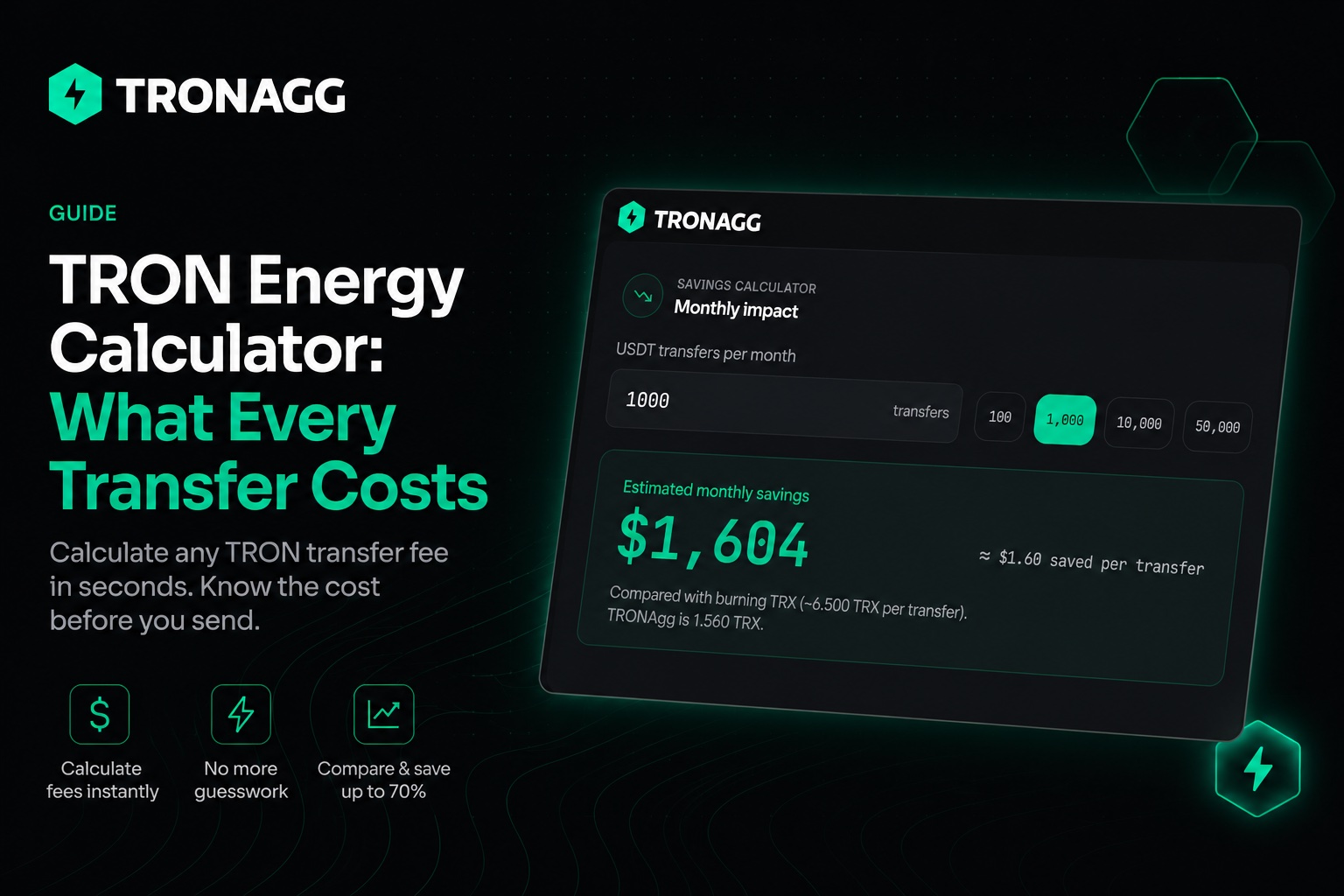
You send 100 USDT on TRON and the network takes 6.5 TRX in fees. A week later, the same transfer to a different address costs 13 TRX. Neither number is random. TRON prices every transaction in energy, and energy converts to TRX at a fixed, published rate. This guide walks through the math a TRON energy calculator runs, so you can check any transfer cost yourself, and shows where to see live prices before you send.
What does a TRON energy calculator do?
A TRON energy calculator converts the energy a transaction consumes into its cost in TRX. It takes two inputs: how much energy the transaction needs (about 65,000 units for a standard USDT transfer) and the current network price per energy unit (100 SUN). Multiply the two, divide by 1,000,000 to convert SUN into TRX, and you have the fee.
These tools exist because TRON does not show the fee before you sign. The wallet deducts TRX after the transaction runs, and the amount depends on the recipient's address state, which most senders never think to check. A calculator tells you the number in advance. If you are new to the resource system itself, start with what TRON energy is and come back for the numbers.
The formula: calculate TRON energy costs by hand
You do not need a tool for a single transfer. The whole calculation fits in one line.
TRON energy cost formula: energy needed × price per unit in SUN ÷ 1,000,000 = fee in TRX. A standard USDT transfer needs about 65,000 energy at 100 SUN per unit: 65,000 × 100 ÷ 1,000,000 = 6.5 TRX.
Two worked examples cover most real cases:
- USDT to an address that already holds USDT: 65,000 energy × 100 SUN = 6,500,000 SUN = 6.5 TRX.
- USDT to an address with a zero USDT balance: about 130,000 energy × 100 SUN = 13,000,000 SUN = 13 TRX. The contract writes a new balance entry for the recipient, and that write costs roughly double.
One date matters here. The energy unit price is set by network governance, not by a fee market. Proposal #104 cut it from 210 SUN to 100 SUN in August 2025. Pages written before that still quote 13 to 27 TRX per transfer, which is double today's real TRON energy cost. If a calculator or article shows those numbers, it is working from stale data.
Bandwidth adds a small amount on top. A TRC-20 transfer consumes about 345 bandwidth points, each account gets 600 free points per day, and past the free quota a point costs 0.001 TRX, so about 0.35 TRX per transfer. Our breakdown of TRON fees covers bandwidth in more detail. Any USDT TRC20 fee calculator worth using runs these same steps against live chain data instead of a hardcoded table.
How much energy common transactions use
Energy consumption depends on the transaction type and the recipient, not on the amount you send.
| Transaction | Energy | Fee if you burn TRX |
|---|---|---|
| USDT to an address holding USDT | ~65,000 | ~6.5 TRX |
| USDT to an address with zero USDT | ~130,000 | ~13 TRX |
| Plain TRX transfer | 0 (bandwidth only) | 0 to ~0.27 TRX |
| Other TRC-20 tokens and contract calls | varies by contract | varies |
Sending 10 USDT and sending 10,000 USDT consume the same 65,000 energy, because the contract does the same work either way. The fee is flat per transfer, which is why batching several payments into one transfer saves money on TRON.
For a deeper look at consumption across wallets, contract types, and multi-transfer days, see how much TRON energy you need.
Burn vs stake vs rent: three ways to pay
Every TRON transaction fee comes down to one of three payment methods, and the calculator result reads differently depending on which one you use.
| Factor | Burn TRX | Stake TRX | Rent energy |
|---|---|---|---|
| Cost per USDT transfer | ~6.5 TRX | 0 after setup | from ~2.6 TRX (1-hour rental) |
| Upfront capital | none | none | |
| Getting your TRX back | n/a | 14-day unstaking period | n/a |
| Setup effort | none | freeze TRX in your wallet | place an order, energy arrives in about a minute |
| Best for | rare one-off transfers | steady daily volume plus idle TRX | everyone in between |
Bottom line: burning is fine if you send USDT a few times a year. Staking pays off only if you hold a large TRX balance you will not need for months. Renting covers the wide middle: no capital locked, and each transfer costs roughly half the burn price or less.
What renting TRON energy costs by duration
Rental prices are quoted in SUN per unit of energy and rise with duration. These are typical market ranges across providers in 2026:
| Duration | Typical price (SUN/unit) | Cost for 65,000 energy |
|---|---|---|
| 1 hour | 40-60 | 2.6-3.9 TRX |
| 1 day | 50-80 | 3.25-5.2 TRX |
| 3 days | 80-120 | 5.2-7.8 TRX |
| 7 days | 120-180 | 7.8-11.7 TRX |
| 14 days | 200-350 | 13-22.75 TRX |
| 30 days | 400-600 | 26-39 TRX |
The short end is where the savings sit. A 1-hour rental at 40-60 SUN covers a transfer for 2.6-3.9 TRX against a 6.5 TRX burn, a 40-60% reduction. Long durations cost more per unit because the provider's TRX stays locked longer; they make sense when you need energy available around the clock, not for single transfers.
Prices move with market demand, and the spread between providers on the same duration is often 20-30%. That spread is the reason to compare quotes before you buy TRON energy rather than take the first offer. TRONAgg checks prices across verified providers in real time and sorts them by total cost.
Using the live calculator on TRONAgg
A TRON transaction cost calculator is only as accurate as its price feed. The calculator on TRONAgg's pricing page works from live marketplace quotes, so the numbers match what you would pay right now. Checking your own volume takes about a minute:
- Open the pricing page: the savings calculator sits below the live price chart.
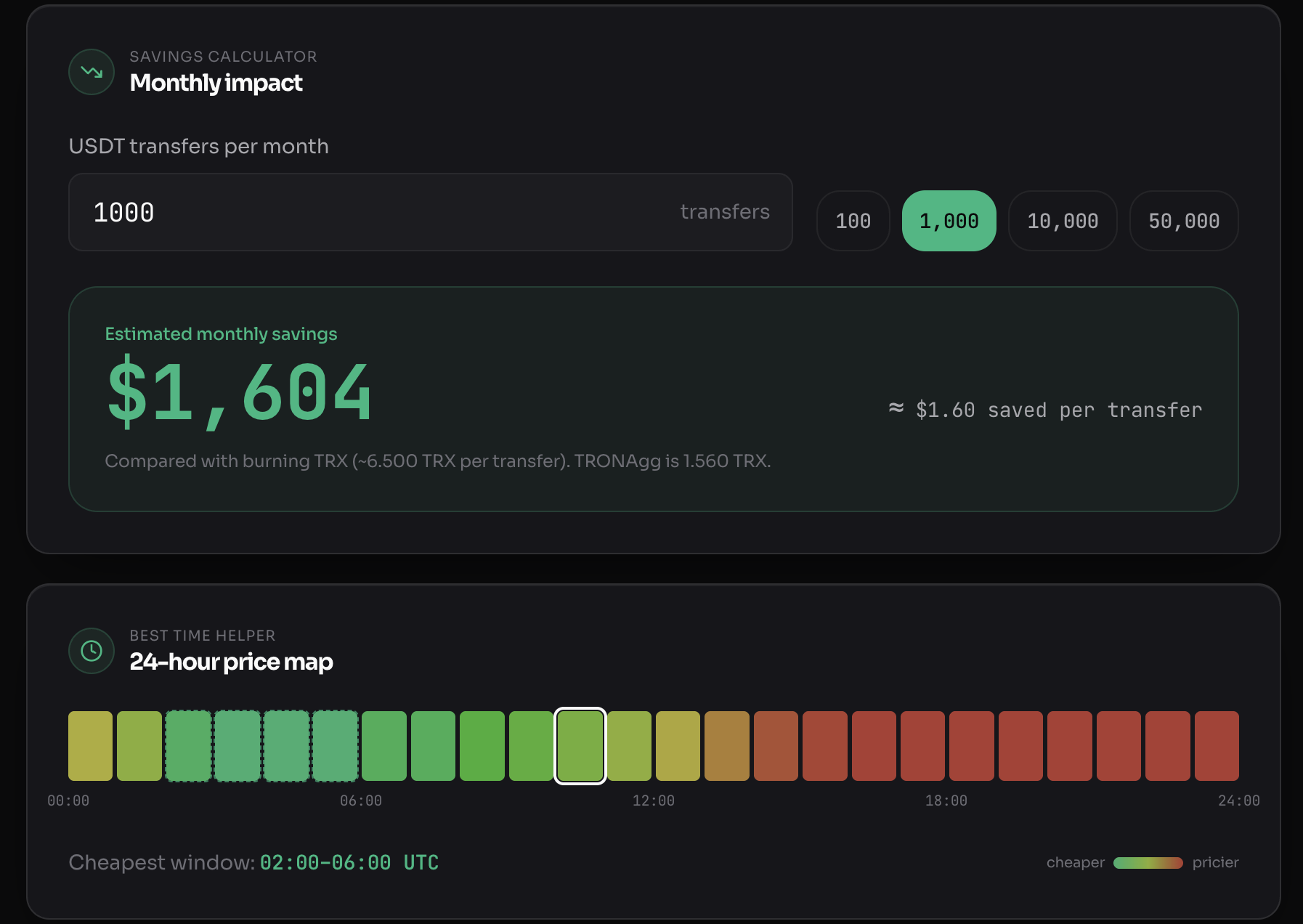
- Enter your monthly transfer count: type a number or use the presets (100, 1,000, 10,000, 50,000).
- Read the result: the tool compares the current rental quote for a 65,000-energy order against the burn cost of the same transfer and shows the difference in USD per month.
- Check the 24-hour price map: the same page charts average energy prices by hour and marks the cheapest 4-hour window in UTC. Rental prices swing during the day, so timing bulk orders to that window lowers the bill further.
No account or wallet connection is needed for any of this. The calculator reads the same data feed that powers the marketplace search.
Frequently asked questions
How much energy do I need for a USDT transfer?
About 65,000 energy for a transfer to an address that already holds USDT, and about 130,000 if the recipient's USDT balance is zero. The transfer amount makes no difference. Other TRC-20 tokens have their own consumption levels, usually in the 30,000-130,000 range depending on the contract.
How much TRX does one USDT transfer cost?
Around 6.5 TRX to an active address and 13 TRX to an empty one, if you pay by burning TRX. At a TRX price of $0.23 that is $1.50-3.00 per transfer. Renting energy first cuts the cost to 2.6-3.9 TRX for a 1-hour rental, and staked energy covers it in full.
Why does sending USDT to a new wallet cost double?
The USDT contract stores a balance entry for every holder. When the recipient's balance is zero, the transfer writes a new entry, and writing new data to the chain costs about twice the energy of updating an existing entry: 130,000 units instead of 65,000. Once the recipient holds any USDT, later transfers to them get the cheaper rate.
Does the transfer amount change the fee?
No. The contract runs the same code whether you send 10 USDT or 10,000 USDT, so both consume the same energy. Fees on TRON are flat per transaction. One transfer of 5,000 USDT costs a fraction of what fifty transfers of 100 USDT would.
How can I avoid burning TRX on transfers?
Get the energy before you send. Rent it from a provider for the duration you need, from 1 hour to 30 days, or stake TRX to generate energy daily. Rented energy arrives in about a minute and needs no locked capital, which makes it the practical choice for most senders.
What is SUN and how do I convert it to TRX?
SUN is the smallest unit of TRX: 1 TRX = 1,000,000 SUN. Energy prices are quoted in SUN per unit, which is why the conversion appears in every fee calculation. For example, 65,000 energy at 100 SUN per unit is 6,500,000 SUN, or 6.5 TRX.
How much TRX do I need to stake to cover one transfer a day?
Roughly 7,027 TRX, worth about $1,616 at $0.23 per TRX. One staked TRX generates about 9.25 energy per day, and the ratio moves with the total amount staked network-wide. Unstaking takes 14 days, so treat staking as a commitment, not a quick option.
Which option fits you
The math points different senders in different directions. If you transfer USDT a few times a year, burning 6.5 TRX per transfer is not worth optimizing. If you send weekly or daily, a rental cuts each transfer to 2.6-5 TRX with no capital locked; run your own volume through the calculator on the pricing page to see the monthly difference. If you move hundreds of transfers a day and hold spare TRX, staking a base amount and renting on top for spikes is the cheapest structure. In all three cases the fee is knowable before you send: 65,000 energy, times the current price, divided by a million.